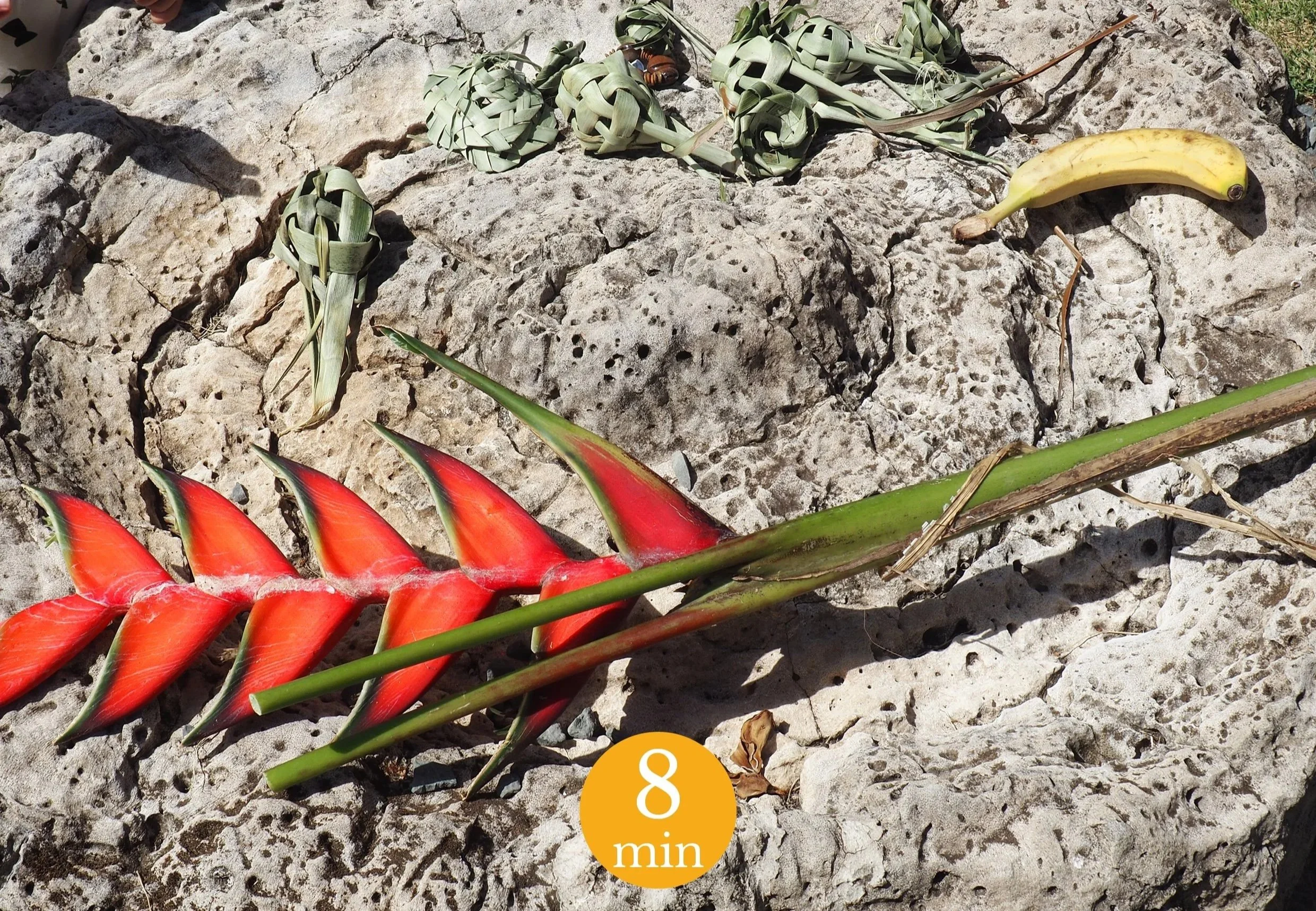
Offerings in the form of flowers, woven objects and fruits left on one of the latte during the Latte Stone Ceremony at the Bishop Museum on 15th June 2024. © Alba Ferrándiz Gaudens
The road to the eventual return of the more than 10,000 artefacts from the Mariana Islands collected by Hans Hornbostel in the 1920s took a long way to be paved. As mentioned in part I of this article, informal requests from the Chamorro community for the return of the so-called Hornbostel collection took place for many years. It was not until the end of 1990, that the Guam Legislature introduced a bill that addressed the need for an adequate facility that could store ‘Guam’s precious historical documents and artifacts’.1 Over 19 million dollars were allocated to improve the storage facilities of the Guam Museum, which would be tasked with storing and caring for the remains and objects after their return to Guåhan (indigenous name for Guam). However, it was not until 1999 that the repatriation of the remains was requested after an inventory of the collection was completed by the Bishop Museum. After months of negotiation between the Government of Guam and the Bishop Museum, on the 22nd of August 2000, 311 ancient Chamorro skeletal remains were repatriated to Guåhan from the Bishop Museum with the support of local Hawaiian businesses and non-profit organisations.2 The negotiations were particularly challenging given that, despite Guåhan being a U.S. territory, federal legislation such as the Native American Graves Protection Act (NAGPRA)3 does not apply to the Marianas (some of the intricacies of this process are outlined in the Ancestral Remains Task Force report). In this sense, the return of the ancestral remains removed by Hornbostel is an early example of Chamorro-Hawaiian commitment to collaboration and mutual solidarity, which is particularly important in light of the parallel forms of colonial occupation that both territories suffer.
A ceremony to welcome the ancestral remains back home was held on 22nd August 2000. The ancestral remains were then transferred to a specially prepared space at the Guam Museum. Before long, public consultations, newspaper polls, and the gathering of local testimonies were held across the island, along with other efforts to involve the community, all aimed at deciding together what should be done with the remains.4 In 2000, the report compiled by the Task Force already expressed the desire for the rest of the Hornbostel collection to return:
We feel that work should continue towards repatriating well over 2,000 artifacts, including a latte, stored at the Bishop Museum. We believe that repatriation of the artifacts should be vigorously pursued in the year 2001. During Aguon’s [Lynda Aguon, Representative of Board of Trustees of the Dipattamenton I Kaohao Guinahan Chamorro/Department of Chamorro Affairs] trip in August, she noticed when she toured the Bishop Museum that only two Guam artifacts were displayed. A majority of the "stored" artifacts are slingstones and fishhooks. These should be immediately returned to our island where they were outright and systematically taken and shipped 3,800 miles from i tano'-ñiha [their people and their land] for the benefit of an enterprise.5
It would not be until 2023, however, that the formal conversations about the return of the remaining artefacts would resume, framed under the Bishop Museum’s scheme ethical returns outside of NAGPRA obligations.6 Throughout the year, Guam Museum Curator Michael Bevacqua coordinated a series of online consultations with local and diasporic Chamorros to explore their views on the possibility of re-starting the process of return, as well as about the temporary relocation of the seven latte to a more central location at the Bishop Museum, which until this point had been on display in the rear courtyard of the museum.7 While Bishop Museum curators Sarah Kuaiwa and Healoha Johnston were finalising their report on the Hornbostel collection in early 2024, members of the Chamorro diaspora in Honolulu worked to relocate the latte in preparation for a ceremony that would take place on the last day of the 2024 Festival of Pacific Arts and Culture (FestPac). Cultural festivals hold deep meaning for Chamorros, especially for those living away from home. Among them, FestPac stands out as a powerful gathering that unites thousands from across the Pacific. When the 13th Festival was held in Honolulu, Hawaiʻi, it became a rare and meaningful convergence, bringing together Chamorros from the islands and those from the diaspora across Hawaiʻi and the United States. On 15th June 2024, hundreds of Chamorros, Micronesians and other Pacific Islanders gathered in the central courtyard of the museum to honour the latte and celebrate their return to a more public setting where people, and particularly members of the Chamorro community, could interact with them until their eventual return to the Marianas.
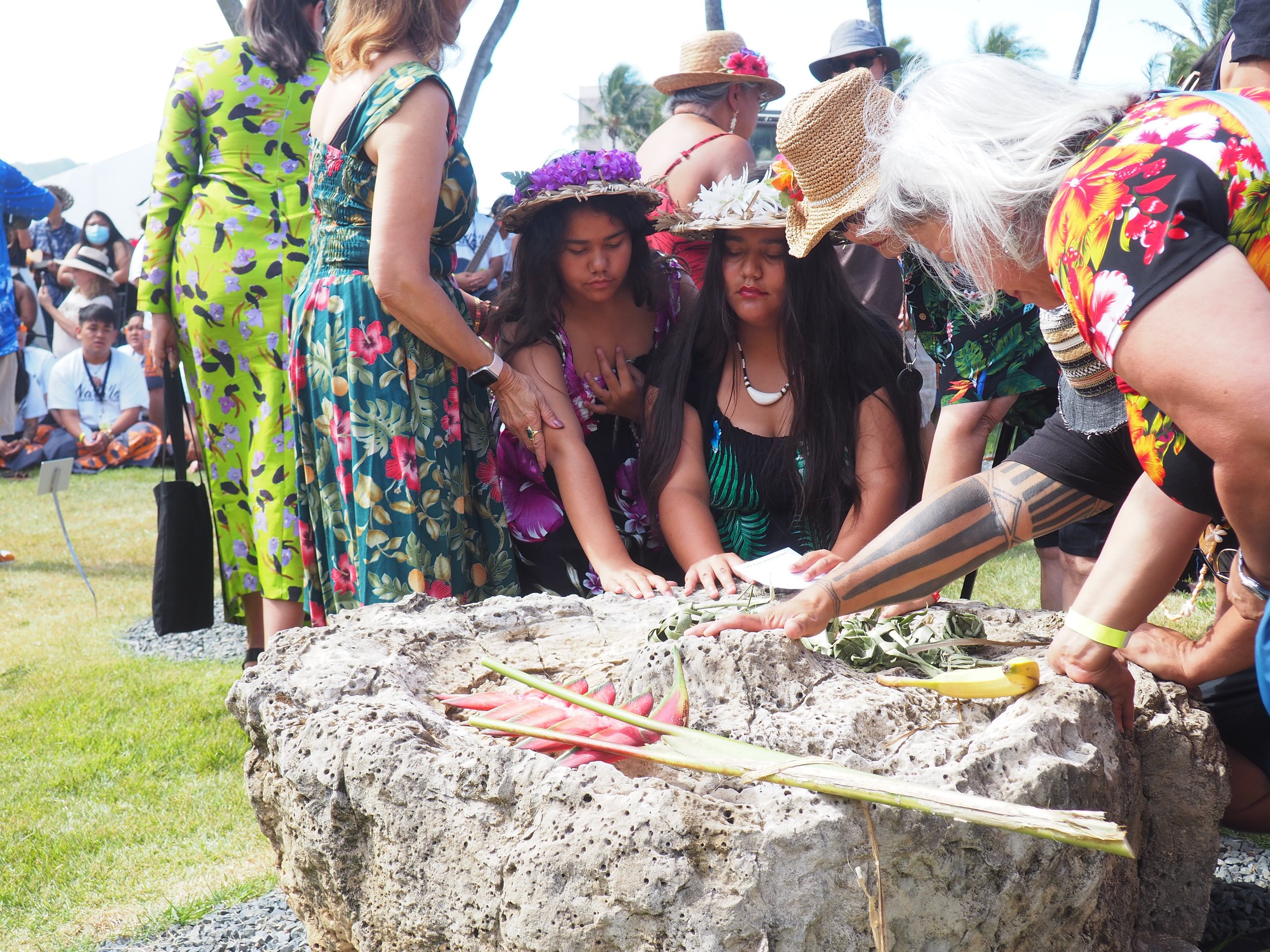
Different generations of Chamorro descendants reconnect with the latte through offerings and touch at the Latte Stone Ceremony on the 15th June 2024. ©Alba Ferrándiz Gaudens
The Latte Stone Ceremony was deeply emotional, with people chanting, dancing, leaving offerings and reconnecting with the stones that embody the spirits of their saina (ancestors).8 During the ceremony, several important cultural practitioners from the Northern Mariana Islands such as Faye Untalan, Donald Mendiola and Frances Sablan spoke directly to the saina, assured them that they would be treated in a respectful manner throughout the ceremony, and that the community was actively working towards their return. The Guåhan performance delegation, in Honolulu at the time for FestPac, also chanted and performed for the latte. Talking about the chants and dances they performed during FestPac, Frances Meno (head of the performing delegation) pointed out that “they are about moving forward and remembering who the Chamorro people were through the elders and honoring them”.9 Additionally, people laid flowers, coconut oil, coconut leaf baskets and other woven items atop the stones as symbols of respect for their ancestors. Although the Latte Stone Ceremony was the most visible event around the Hornbostel collection at the time, the Bishop Museum, in collaboration with Michael Bevacqua of the Guam Museum and Nicole Delisle Duenas of the Guam Cultural Repository, arranged a visit for Guåhan and Northern Mariana Islands FestPac delegates to view and handle parts of the Hornbostel collection.10
“At times, seeing and being able to hold an artifact that a Chamorro hand may not have held for hundreds, perhaps thousands, of years, especially for the group of carvers that were present, to be able to admire the skill of their ancestors brought tears of pride” Bevacqua shared about the visit on his Facebook page.
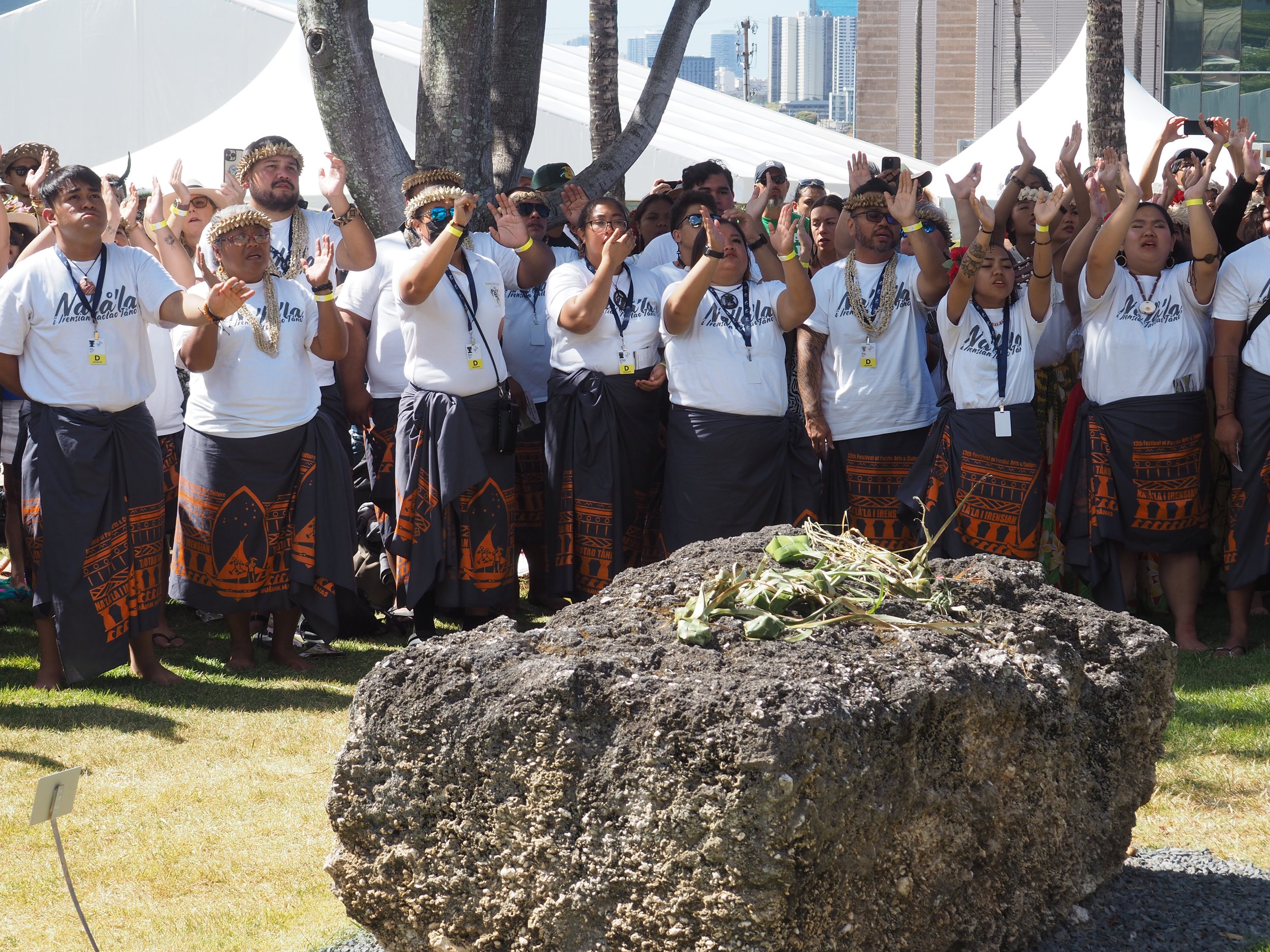
Members of the Guåhan performance delegation chant and dance in honour of the saina (ancestors) embodied in the latte at the Bishop Museum during the Latte Stone Ceremony on the 15th June 2024. ©Alba Ferrándiz Gaudens.
The echoes of the events held during FestPac lead negotiations to continue between the governments of Guåhan and the Northern Mariana Islands with the Bishop Museum’s board of trustees. Finally, in August 2025, the Bishop Museum announced the return of the more than 10,000 artefacts collected by Hans Hornbostel. On 9th August 2025, the museum hosted a small ceremony with the participation of Josh Tenorio (Guåhan’s Lieutenant Governor), Henry Hofschneider (the chief of staff of NMI Governor David Apatang) Melvin Won-Pat Borja (president of the Guam Department of CHamoru Affairs) and Josh Green (Governor of Hawaiʻi). During his speech, Tenorio spoke of the process to “right the wrongful removal” of artefacts and human remains from the Marianas:
Today’s ceremony is not simply to start the process of return but to earnestly begin the process of rematriation of artefacts to their rightful homelands and their indigenous Chamorro and Carolinian communities. Rematriation, as opposed to repatriation is focused on restoring the relationship between an indigenous people and the culture and land of their ancestors… The infamous removal of these artefacts and the set of latte before us by Hans Hornbostel were emblematic of the policies and violations leveled against the indigenous Chamorro at a very different time, which disregarded the sanctity and sacredness of the artifacts’ original placement by our ancestors. This issue is not unique to just the indigenous Chamorro people of the Marianas but has regrettably affected indigenous communities across the globe especially here in the Pacific.11
Rematriation is a concept that arises from Indigenous scholarship to refer to the community-led process of return of ancestral remains and objects as a way to reclaim knowledge, stories and ancestral belongings.12 It is not a coincidence that Guåhan’s Lieutenant Governor used this term to describe the return of the Hornbostel collection. Today, Chamorro people are actively trying to define their own identity as Indigenous peoples and situating their struggles within broader movements for the recovery of Indigenous knowledge and culture, decolonization and self-determination.
On the Hawaiian side, the discourse revolved around the reparation of historical damage. Bishop Museum CEO Deejay Miller stated that the ethical return of the Hornbostel collection symbolises the museum’s commitment to taking fast and meaningful action to address historical injustices.13 In a similar vein, Governor Green said that this return was “a long time coming” and represented the beginning of an enduring commitment to honour and protect the political and cultural ties uniting Hawaiʻi and the Mariana Islands.14 Beyond ensuring the return of these ancestral treasures to Guam, the partnership between the two communities also established a foundation for the long-term growth and development of the Guam Museum and the Northern Marianas Museum in collaboration with the Bishop Museum, including the training of professional staff in the Marianas through the Bishop Museum’s Te Rangi Hiroa Curators and Caretakers Fellowship programme.15
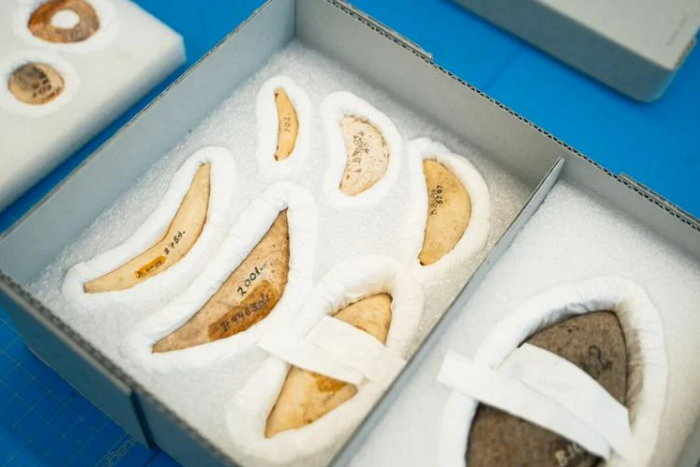
Some sinahi (half-moon shaped pendants), slingstones and shell adornments carefully packed for their journey back home to the Mariana Islands in August 2025. ©Guam Pacific Daily News https://www.guampdn.com/news/right-the-wrongful-removal-latte-stones-10-000-artifacts-on-their-way-back-to-guam/article_41f99636-fcfa-44bf-8b4b-b7159290bb3c.html
After the ceremony, a set of artefacts was transported back to the islands by those representatives present at the event (a first set of artefacts had already been returned by Michael Bevacqua in an earlier trip he made to Honolulu). Between 6th and 12th September, a special exhibition titled Iyo-ta Gi Tano’-ta Ta’lo (Ours in Our Land Again) was held at the Guam Museum to welcome those artefacts home and restore connections between them and the community. 16 According to Bevacqua “more than a hundred came… to hear the history about the Hornbostel Collection… and to celebrate getting this collection back home”. 17 While a selection of rare artefacts was displayed in this event, thousands of artefacts are still waiting to be returned to the Mariana Islands. This process will be lengthy and will require collaboration between multiple institutions, including the United States Navy who has agreed to transport the heavy latte back to the islands. 18 The Navy’s participation in the return is highly significant, marking the start of its accountability and reparation for its crucial role in the removal of these artifacts. 19 It also signals a commitment to ongoing collaboration, acknowledging the complex relationship between the people of the Marianas and the U.S. military.
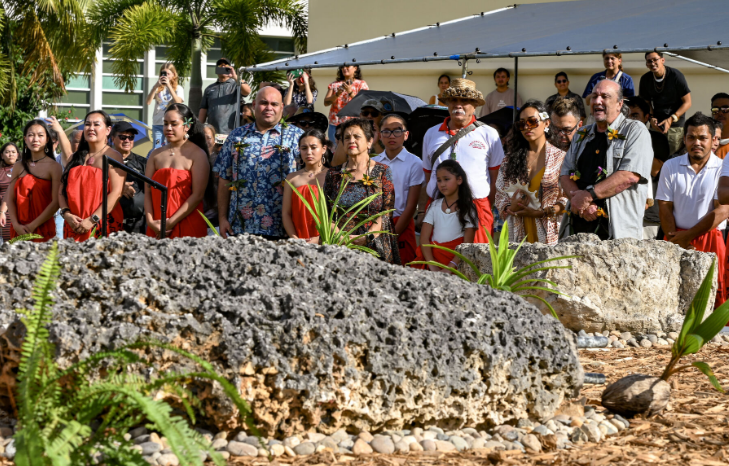
Governor Lou Leon Guerrero and Lieutenant Governor Josh Tenorio of Guåhan during a bendision or blessing for the returned latte at Skinner Plaza in front of the Guam Museum, 24th October 2025. ©Rick Cruz/Guam Pacific Daily News https://www.guampdn.com/multimedia/photos-rematriation-ceremony-held-for-returned-ancient-latte-stone-artifacts/collection_912f4828-3d73-4c9d-9d33-91c6b4e3e618.html
On 24th October 2025, the people of Guam held a rematriation ceremony in front of the Guam Museum to honour the return of some of the latte from Honolulu, which will be on display in the central plaza for some time until they find a permanent home. More than two hundred people gathered to chant – led by island youth –, leave offerings and touch the latte to welcome them and the spirits of the saina back to the island. The Governor of Guåhan, Lou Leon Guerrero, officially welcomed the latte and said that “This has been a long, long, long time coming where now we have welcomed back our ancestors.”20 The ceremony was a deeply emotional moment filled with healing and resilience. Parallelly, one of the NMI latte from Luta (Rota) that was purchased by a private collector in 1950 and later donated to the Bishop Museum has also returned to Saipan.21 A public ceremony to welcome this latte home to the Northern Marianas is scheduled to take place in November. Even though some of the latte and objects have made their ways back to the Marianas, another 6,000 artefacts wait patiently for their return home.
Alba Ferrándiz Gaudens
1 Ancestral Remains Task Force, 2000. Report on the Disposition of Ancestral Remains aka “Hornbostel Collection”. p. 2.
2 Ancestral Remains Task Force, 2000. Report on the Disposition of Ancestral Remains aka “Hornbostel Collection”.
3 Ancestral Remains Task Force, 2000. Report on the Disposition of Ancestral Remains aka “Hornbostel Collection”.
4 Ancestral Remains Task Force, 2000. Report on the Disposition of Ancestral Remains aka “Hornbostel Collection”. pp. 18-19.
5 Pacific Island Times News Staff, 2025. ‘Correcting 'historical injustice:' Archaeological riches whisked away in 1900s finally returning to Guam, CNMI’. Pacific Island Times, 11 August 2025,
6 Fanachu! Live Podcast, 2024. ‘Gi Oriyan I Latte ni Gaige gi Museon Bishop giya Hawaiʻi’ moderated by Dr. Michael Lujan Bevacqua, June 26, 2024, Youtube,
https://www.youtube.com/watch?v=_udqhzuQVjE
7 Marsh Taitano, K. and Liston, J. (Eds.), 2021. The Latte in the Marianas: By the Community for the Community. Mangilao, Guam: The Latte in the Marianas: Art, Icon and Archaeology Project.
8 Frances Meno in Sablan, J., 2024. ‘Letting the world know about the CHamoru people through dances’, Guam Pacific Daily News, 4 June 2024
9 Furukawa, J., 2024. ‘Reclaiming what belongs to Guam: Hornbostel Collection final report nearly complete’. Pacific Island Times, 18 July 2024
https://www.pacificislandtimes.com/post/reclaiming-what-belongs-to-guam
10 OiwiTV, 2025. ‘Ceremony in Honor of the Return of the Latte Stones - LIVE from The Bishop Museum’. Youtube, 9 August 2025, min. 31:00
https://www.youtube.com/live/TT4fl80fDBE
11 Gray, R. R. R., 2022. ‘Rematriation: Ts'msyen Law, Rights of Relationality, and Protocols of Return’. Native American and Indigenous Studies 9(1), 1-27.
12 Gilbert, H. E., 2025. ‘”Right the wrongful removal': Latte stones, 10,000 artifacts on their way back to Guam, CNMI from Hawaii”’. Guam Pacific Daily News, 10 August 2025
13 Gilbert, H. E., 2025. ‘”Right the wrongful removal': Latte stones, 10,000 artifacts on their way back to Guam, CNMI from Hawaii”’. Guam Pacific Daily News, 10 August 2025
14 Pacific Island Times News Staff, 2025. ‘Correcting 'historical injustice:' Archaeological riches whisked away in 1900s finally returning to Guam, CNMI’. Pacific Island Times, 11 August 2025
15 Guam Pacific Daily News, 2025. ‘Chance to see, learn more about some of 10K returned artifacts at HITA Talk on Saturday’. Guam Pacific Daily News, 2 September 2025
16 Michael Bevacqua in Aguon Charfauros, J., 2025. ‘A great homecoming at Saturday's Hita Talk’. KUAM News, 9 September 2025
https://www.kuam.com/story/53067704/a-great-turnout-at-saturdays-hita-talk
17 Gilbert, H. E., 2025. ‘”Right the wrongful removal': Latte stones, 10,000 artifacts on their way back to Guam, CNMI from Hawaii”’. Guam Pacific Daily News, 10 August 2025
18 Josh Tenorio in OiwiTV, 2025. ‘Ceremony in Honor of the Return of the Latte Stones - LIVE from The Bishop Museum’, min. 35:30
19 Lou Leon Guerrero in Hirayama, M., 2025. ‘Guam's youth leads rematriation ceremony welcoming home sacred latte’. KUAM News
20 For more information on the journey of the Luta latte, see Manglona II, T., 2025. ‘Rota latte stone returns after 75 years’. Marianas Press
Bibliography:
AGUON CHARFAUROS, J., 2025. ‘A great homecoming at Saturday's Hita Talk’. KUAM News, 9 September 2025 https://www.kuam.com/story/53067704/a-great-turnout-at-saturdays-hita-talk.
Ancestral Remains Task Force, 2000. Report on the Disposition of Ancestral Remains aka “Hornbostel Collection”. 12 December 2000.
Fanachu! Live Podcast, 2024. ‘Gi Oriyan I Latte ni Gaige gi Museon Bishop giya Hawaiʻi’ moderated by Dr. Michael Lujan Bevacqua, June 26, 2024, Youtube, https://www.youtube.com/watch?v=_udqhzuQVjE.
FURUKAWA, J., 2024. ‘Reclaiming what belongs to Guam: Hornbostel Collection final report nearly complete’. Pacific Island Times, 18 July 2024, https://www.pacificislandtimes.com/post/reclaiming-what-belongs-to-guam.
GILBERT, H. E., 2025. ‘”Right the wrongful removal': Latte stones, 10,000 artifacts on their way back to Guam, CNMI from Hawaii”’. Guam Pacific Daily News, 10 August 2025, https://www.guampdn.com/news/right-the-wrongful-removal-latte-stones-10-000-artifacts-on-their-way-back-to-guam/article_41f99636-fcfa-44bf-8b4b-b7159290bb3c.html.
GRAY, R. R. R., 2022. ‘Rematriation: Ts'msyen Law, Rights of Relationality, and Protocols of Return’. Native American and Indigenous Studies 9 (1), pp. 1-27.
Guam Pacific Daily News, 2025. ‘Chance to see, learn more about some of 10K returned artifacts at HITA Talk on Saturday’. Guam Pacific Daily News, 2 September 2025, https://www.guampdn.com/news/chance-to-see-learn-more-about-some-of-10k-returned-artifacts-at-hita-talk-on/article_ed2aaa89-c433-449f-99cc-a82712e7aa71.html.
HIRAYAMA, M., 2025. ‘Guam's youth leads rematriation ceremony welcoming home sacred latte’. KUAM News, 27 October 2025, https://www.kuam.com/story/53193784/guams-youth-leads-rematriation-ceremony-welcoming-home-sacred-latte.
MANGLONA II, T., 2025. ‘Rota latte stone returns after 75 years’. Marianas Press, 28 October 2025, https://sites.google.com/marianaspress.com/marianaspress/news/rota-latte-stone-returns-after-75-years?authuser=0.
MARSH TAITANO, K. and LISTON, J. (Eds.), 2021. The Latte in the Marianas: By the Community for the Community. Mangilao, Guam: The Latte in the Marianas: Art, Icon and Archaeology Project.
OiwiTV, 2025. ‘Ceremony in Honor of the Return of the Latte Stones - LIVE from The Bishop Museum’. Youtube, 9 August 2025, https://www.youtube.com/live/TT4fl80fDBE.
Pacific Island Times News Staff, 2025. ‘Correcting 'historical injustice:' Archaeological riches whisked away in 1900s finally returning to Guam, CNMI’. Pacific Island Times, 11 August 2025, https://www.pacificislandtimes.com/post/correcting-historical-injustice-archaeological-riches-whisked-away-in-1900s-finally-returning-to.
SABLAN, J., 2024. ‘Letting the world know about the CHamoru people through dances’, Guam Pacific Daily News, 4 June 2024, https://www.guampdn.com/lifestyle/letting-the-world-know-about-the-chamoru-people-through-dances/article_c608933c-2154-11ef-b6bd-a3228837461f.html.